
Correcting In-toeing/Out-toeing.
Cascade Dafo offers a guide for optimization considerations for patients who require extra support to counter in-toeing or out-toeing patterns.
It is first important to understand the cause of the in-toeing/out-toeing. If the in-toeing/out-toeing is due to rotational problems at the hips or tibial/femoral torsion, the posture will not be influenced by these modifications. These modifications are most effective when there is laxity at the joints due to low tone.
In-Toeing Optimizations
Option 1
| Post lateral forefoot to lower the longitudinal arch and discourage in-toeing. When the lateral border of the foot is raised, it is difficult to internally rotate the legs and in-toe. | 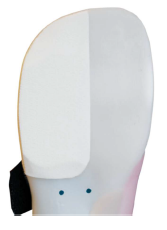 |
Option 2
|
Request a strong lateral toe shelf and cut plastic proximal to metatarsal heads from toes 1-2. The plastic needs to be cut completely away under the 1st and 2nd metatarsal heads to allow for a very flexible break-over point. The stiffness of the plastic under the lateral portion of the forefoot encourages the patient to find an easier break-over point. This helps the patient externally rotate the leg and move over the medial side of the orthosis instead. |
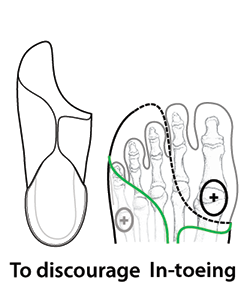 |
Note that these options are mutually exclusive selections that may be more or less suitable for different brace style options or patient needs.
Out-Toeing Optimizations
Option 1
| Post medial forefoot to elevate the longitudinal arch and discourage out-toeing. When the medial border of the forefoot is raised, it is difficult to externally rotate the leg and out-toe. | 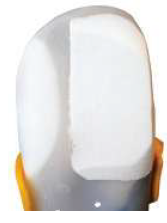 |
Option 2
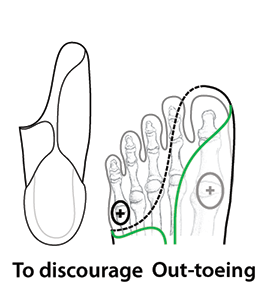
|
Request a strong medial toe shelf and cut plastic proximal to metatarsal heads from toes 3-5. The platsic needs to be cut completely away under the 3rd-5th metatarsal heads to allow for a very flexible break-over point. The stiffness of the plastic under the medial portion of the forefoot encourages the patient to find an easier break-over point. This helps the patient internally rotate the leg and move over the lateral side of the orthosis instead. |
 |
Note that these options are mutually exclusive selections that may be more or less suitable for different brace style options or patient needs.
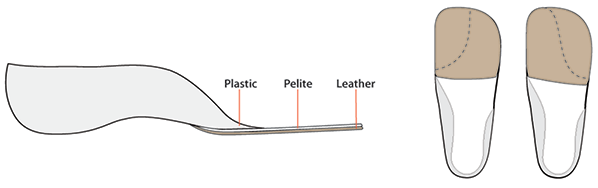
Bottom Treatment
When the plastic has been cut away under the met heads, we extend the plantar surface trimline with pelite and leather.
 |
For any questions, please reach out to our Customer Support team at 800-848-7332